
EU green claims rules are changing. On 27 September 2026, the Empowering Consumers for the Green Transition Directive (ECGTD) becomes enforceable, and for eco brands selling in Europe, vague sustainability language is no longer a grey area. the EU's Empowering Consumers for the Green Transition Directive (ECGTD, Directive 2024/825) becomes enforceable across all EU member states.If your brand sells organic canvas bags, totes, or any textile product to European customers, and your website, hangtags, or marketing still uses words like "eco-friendly," "sustainable," or "green" without certified backing, you are five months away from a compliance problem.This isn't a grey area anymore. Here's exactly what's changing, what's banned, and what you need to do before the deadline.
What Is the EU Empowering Consumers for the Green Transition Directive?
The ECGTD is an EU consumer protection law that regulates how environmental claims can be made about products. Adopted in March 2024, it amends existing EU consumer law to directly address greenwashing at the point of sale.The core principle: any claim that implies environmental benefit, on product pages, hangtags, collection names, or marketing campaigns, must be specific, verifiable, and supported by recognised third-party evidence.Vague language is gone. Self-created eco-labels are banned. And claiming your canvas bag is "carbon neutral" because you bought offsets is now explicitly illegal.Enforcement begins 27 September 2026. Fines can reach up to 4% of annual turnover in the relevant member state.
What Claims Are Now Banned Under ECGTD?
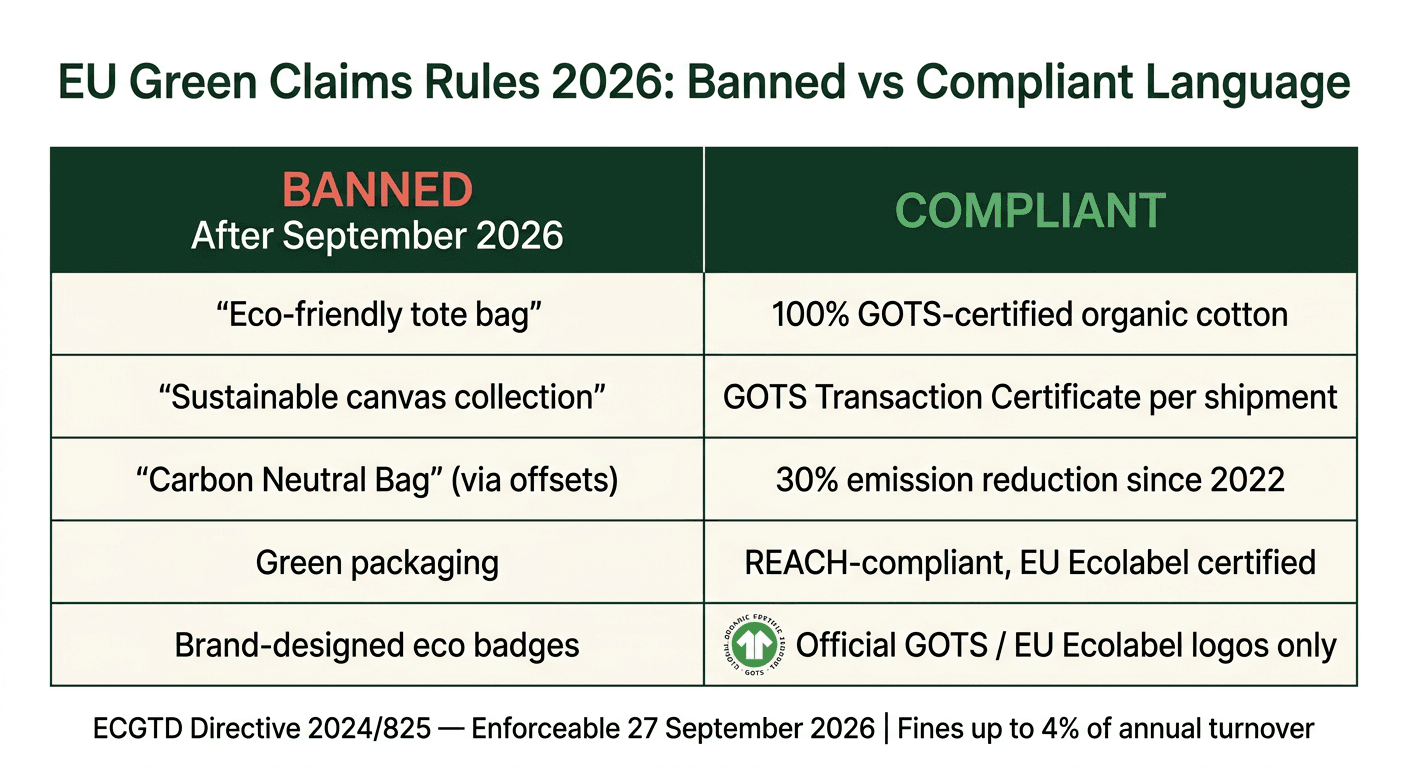
Generic Environmental ClaimsUnless your product holds a recognised official certification like the EU Ecolabel or GOTS, the following terms used without specific substantiation are prohibited:
The replacement rule is simple: Be specific. "Made with 100% GOTS-certified organic cotton, certified per shipment via GOTS Transaction Certificate", that's legal. "Eco-friendly bag", that's not.
The Carbon Offset Trap
This is the biggest disruption for brands that have been buying carbon credits to claim neutrality.
The ECGTD explicitly bans claims that a product has a neutral, reduced, or positive climate impact if that claim relies on carbon offsetting.
Banned: "Carbon Neutral Tote Bag" (because you purchased offsets)
Allowed: "We have reduced manufacturing emissions by 30% since 2022 through [specific action]"You can still communicate your company-level climate investments.
You cannot attach offset-based neutrality claims to a specific product.
You can still communicate your company-level climate investments. You cannot attach offset-based neutrality claims to a specific product.
Self-Certified Sustainability Labels
If your brand has created its own "Green Choice" badge, "Eco Star" icon, or any sustainability-looking logo without third-party certification behind it, it must come down.
Banned: Brand-designed sustainability seals without independent verification
Allowed: Official certification logos, GOTS, OEKO-TEX, EU Ecolabel, BCI, issued by recognised third-party bodies
Why GOTS Certification Is Now a Legal Requirement, Not Just a Selling Point
Before ECGTD, GOTS certification was a competitive advantage. After September 2026, for any brand making organic cotton claims in the EU market, it becomes a compliance prerequisite.But there's a critical distinction most brands, and many suppliers, don't clearly explain:
GOTS Scope Certificate vs. GOTS Transaction Certificate (TC)
For a full breakdown, see our GOTS TC vs Scope Certificate guide.
A supplier can hold a valid GOTS Scope Certificate and still be unable to provide the TC for your specific order, which means you cannot legally claim that shipment is GOTS certified on your product pages or hangtags.
When sourcing organic canvas bags for the European market, always ask: "Can you provide a GOTS Transaction Certificate issued specifically for my order?" If the answer is hesitation, that's your answer.
ECGTD Compliance Checklist: 7 Actions on EU Green Claims
Work through this before September:
What Happens If You Don't Comply?
Penalties are set by individual EU member states but must be "effective, proportionate, and dissuasive." Under the directive, fines can reach 4% of the trader's annual turnover in the relevant member state.
Beyond fines:
Products can be withdrawn from the EU market
Non-compliant claims can trigger consumer authority investigations (Germany's Verbraucherzentrale and the Netherlands' ACM are already active enforcers)
Brand reputation damage in the European eco community is significant and lasting, these buyers talk to each other
The UK is tracking closely. If you sell to UK customers, the Digital Markets, Competition and Consumers (DMCC) Act mirrors the ECGTD. The CMA has already investigated ASOS, Boohoo, and others. One set of compliant hangtags for both markets is the practical strategy.
ECGTD vs. the Green Claims Directive: What's the Difference?
Brands often conflate these two, they're related but distinct:
ECGTD (in force September 2026), The "Stop" regulation. It bans bad practices: generic claims, misleading labels, offset-based neutrality claims. This is what you need to comply with now.
Green Claims Directive (GCD), The "Go" regulation. Still pending final approval, it will set the rigorous methodology for how you substantiate the positive claims you're allowed to make (likely using the Product Environmental Footprint framework). Watch this space for 2027–2028.
Your strategy: Get ECGTD-clean first. GCD preparation comes next.
How to Prepare Your Supply Chain Before the September Deadline
Not sure which country to source from? See our full comparison: China vs India vs Vietnam for GOTS Organic Canvas Bags →
Three actions that have the most impact right now:
1. Switch to a supplier who provides per-order GOTS TC
Not all GOTS-certified factories issue TCs per shipment. Confirm this explicitly before your next order, not after it ships.
2. Request your compliance documentation bundle with every quote
A professional organic canvas supplier should be able to provide, alongside pricing: GOTS TC for the specific order, REACH compliance confirmation, and fibre composition documentation ready for EU labelling requirements.
3. Work backwards from September on your inventory plan
If you need ECGTD-compliant product on shelves by October 2026, you need orders placed and confirmed by June at the latest, allowing for 30–45 day production, 20–30 day sea freight to EU, and receiving time. There is no margin for a supplier swap at the last minute.
The Bottom Line
The ECGTD doesn't punish brands for being sustainable. It punishes brands for claiming to be sustainable without being able to prove it.
For brands that have already done the work, sourcing certified organic materials, demanding per-shipment documentation, building traceable supply chains, September 2026 is not a threat. It's a filter that removes the competition.
The brands still using "eco-friendly" as marketing copy without certification backing will find European market access significantly harder in Q4 2026. The brands with GOTS TC documentation in hand will not.
Oasis Canvas supplies GOTS TC Verified organic canvas bags and fabric to European and US brands. Every order includes a Transaction Certificate issued for your specific shipment, the documentation your brand needs to make certified organic claims under ECGTD. DDP quotes to EU and US delivered within 12 hours.
Wondering what a compliant order actually costs? See our full DDP price breakdown →
Want to verify a supplier's GOTS certificates yourself? Follow our step-by-step due diligence guide: How to Verify a GOTS Certificate →