
Why GOTS Certificate Fraud Is More Common Than You Think
GOTS certificate verification is the first line of defense against supplier fraud.A GOTS logo on a supplier's website costs nothing to put there.
A GOTS Scope Certificate PDF can be altered in under five minutes by anyone with basic design software. Expiry dates changed. Product categories added. Company names substituted.
This is not a hypothetical problem. The GOTS organisation itself publishes periodic alerts about fraudulent use of its certification marks. In the organic textile supply chain, certificate misrepresentation ranges from outright forgery to more subtle misuse, a factory sharing a single SC across multiple unrelated facilities, or a supplier presenting a certificate from a sister company as their own.
For European brands, the stakes after September 2026 are direct. If you make a GOTS organic claim on your product page or hangtag and the certificate behind it does not hold up to scrutiny, you are exposed under the ECGTD, regardless of whether your supplier deceived you. The compliance obligation sits with the brand.
For a full overview of what ECGTD requires from your supply chain, see our compliance guide: EU Green Transition Directive 2026: What Eco Brands Must Do Before September →
The good news: GOTS certificate verification takes about ten minutes per supplier. Here is exactly how to do it
Part 1: GOTS Certificate Verification, Official Database Walkthrough
The GOTS public database is the only authoritative source for certificate verification. A certificate PDF sent by a supplier proves nothing on its own, it must match what is in the database.
Step 1: Go to the GOTS certified suppliers database
Navigate to: https://www.global-standard.org/the-standard/gots-certified-facilities
This is the official GOTS public database, updated in real time by approved certification bodies.
Step 2: Search by company name or certificate number
Enter the supplier's company name exactly as it appears on their certificate. If the name returns no results, try the certificate number (printed on the SC document, usually in the format CB-XX-XXXXXX).
Step 3: Check these five fields against the certificate PDF
The most common verification failure: A supplier holds a valid GOTS SC for fabric production, but not for finished goods. They can legitimately produce certified fabric, but cannot certify the finished bag as GOTS-compliant. If you are buying finished bags, the SC must explicitly cover finished goods.
Step 4: Note the certification body
The certification body (CB) name is listed in the database. Save this, you will need it when verifying the Transaction Certificate.
Not sure which sourcing country has the strongest TC infrastructure? See our full comparison: China vs India vs Vietnam: Where to Source GOTS Organic Canvas Bags for the EU Market →
Part 2: How to Verify a GOTS Transaction Certificate
A Scope Certificate tells you a factory is approved to produce certified goods. A Transaction Certificate tells you your specific shipment is certified. For EU compliance post-ECGTD, the TC is the document that legally protects your product-level claims.
For a full explanation of why the TC matters more than the SC for EU brands, see our breakdown: GOTS Transaction Certificate vs Scope Certificate: What Canvas Bag Buyers Must Know →
What a legitimate TC must contain:
How to verify a TC:
Unlike the SC, TCs are not all searchable in a single public database, they are issued by individual certification bodies. To verify a TC:
1.Note the certification body named on the TC
2.Go directly to that CB's website (e.g. Control Union, Ecocert, OneCert, CCPB)
3.Most CBs have a certificate verification portal where you can enter the TC number
4.If no portal exists, contact the CB directly with the TC number, they will confirm validity within 24–48 hours
The question to ask before the order, not after:
At the sample stage, ask your supplier: "Can you send me a sample TC from a previous order, with the buyer name redacted, so I can verify the format and certification body?"
A supplier who issues TCs regularly will have this available immediately. A supplier who hesitates has told you something important.
Part 3: Five Red Flags That Indicate a Certificate Problem
These are the patterns that most commonly indicate certificate misrepresentation or non-compliance. If you encounter any of them, pause the order and verify directly with the certification body before proceeding.
🚩 Red Flag 1: The Certificate Name Doesn't Match the Factory You're Dealing With
The SC is issued to a specific legal entity. If you are dealing with "Yangzhou Textile Co. Ltd" but the certificate is issued to "Jiangsu Green Fabrics Group," these are different entities. A group SC does not automatically cover all subsidiaries.
What to do: Ask the supplier to explain the corporate relationship and confirm that the certificate specifically covers the production facility processing your order. Get this in writing.
🚩 Red Flag 2: The Certificate Covers a Different Product Category Than What You're Ordering
A factory may hold a valid GOTS SC for yarn spinning or fabric weaving, but not for finished goods manufacturing. Bags are a distinct product category under GOTS, a fabric SC does not certify the finished bag.
What to do: Check the "product categories" field in the GOTS database against what you are buying. If the SC doesn't cover finished goods, the supplier cannot issue a TC for your bag order.
🚩 Red Flag 3: The Supplier Cannot Produce a TC from a Previous Order
If a supplier claims to issue TCs per order but cannot show you a redacted sample from a prior shipment, they almost certainly cannot issue one for yours. Legitimate TC-capable factories have a paper trail.
What to do: Ask for a redacted sample TC at the sample stage. If they can't produce one in 48 hours, treat this as a disqualifying issue.
🚩 Red Flag 4: The TC Names Multiple Buyers or Has No Buyer Name
A genuine per-order TC is issued to one buyer for one shipment. A TC that lists multiple companies, has a blank buyer field, or uses a generic buyer name ("Various buyers" or "Consignee as per invoice") is not order-specific and does not provide ECGTD-compliant product-level certification.
What to do: Reject any TC that does not name your company specifically. This is non-negotiable under ECGTD.
🚩 Red Flag 5: The Expiry Date on the PDF Doesn't Match the Database
Certificate PDFs can be altered. If the expiry date on the PDF your supplier sent is different from what appears in the GOTS public database, or if the certificate number in the PDF returns no results in the database, the document has been tampered with.
What to do: Stop the order. Report the discrepancy to the GOTS organisation via their official contact page. Do not proceed until the issue is resolved.
Part 4: How to Verify REACH Compliance and Fibre Composition Documentation
GOTS certification covers the organic supply chain. It does not automatically cover EU chemical safety (REACH) or textile labelling requirements. For EU market access, you need both.
Verifying REACH Compliance
A REACH compliance declaration confirms that the finished goods meet EU REACH Regulation (EC) No 1907/2006 restrictions on hazardous substances, including azo dyes, chromium VI, nickel, formaldehyde, and phthalates.
What to check on a REACH declaration:
A factory-issued self-declaration ("We confirm our products comply with REACH") is not sufficient. You need a test report from an accredited third-party laboratory.
Verifying Fibre Composition Documentation
EU Textile Regulation (Regulation EU 1007/2011) requires that all textile products sold in the EU carry a label stating full fibre composition in the official language(s) of each country where they are sold.
For organic canvas bags, your supplier should provide a fibre composition test report confirming:
This report should be issued by the same accredited laboratory as the REACH declaration, or by the GOTS certification body as part of the TC issuance process.
The practical check: Does the fibre composition on the test report match what will appear on your hangtags and product pages? If your marketing says "100% GOTS organic cotton, 12oz canvas," the test report must confirm 100% cotton at the specified weight. Any discrepancy is a labelling compliance risk.
The Verification Checklist at a Glance
Run this before committing to any new supplier, and repeat it annually for existing suppliers, since certificates expire and production lines change.
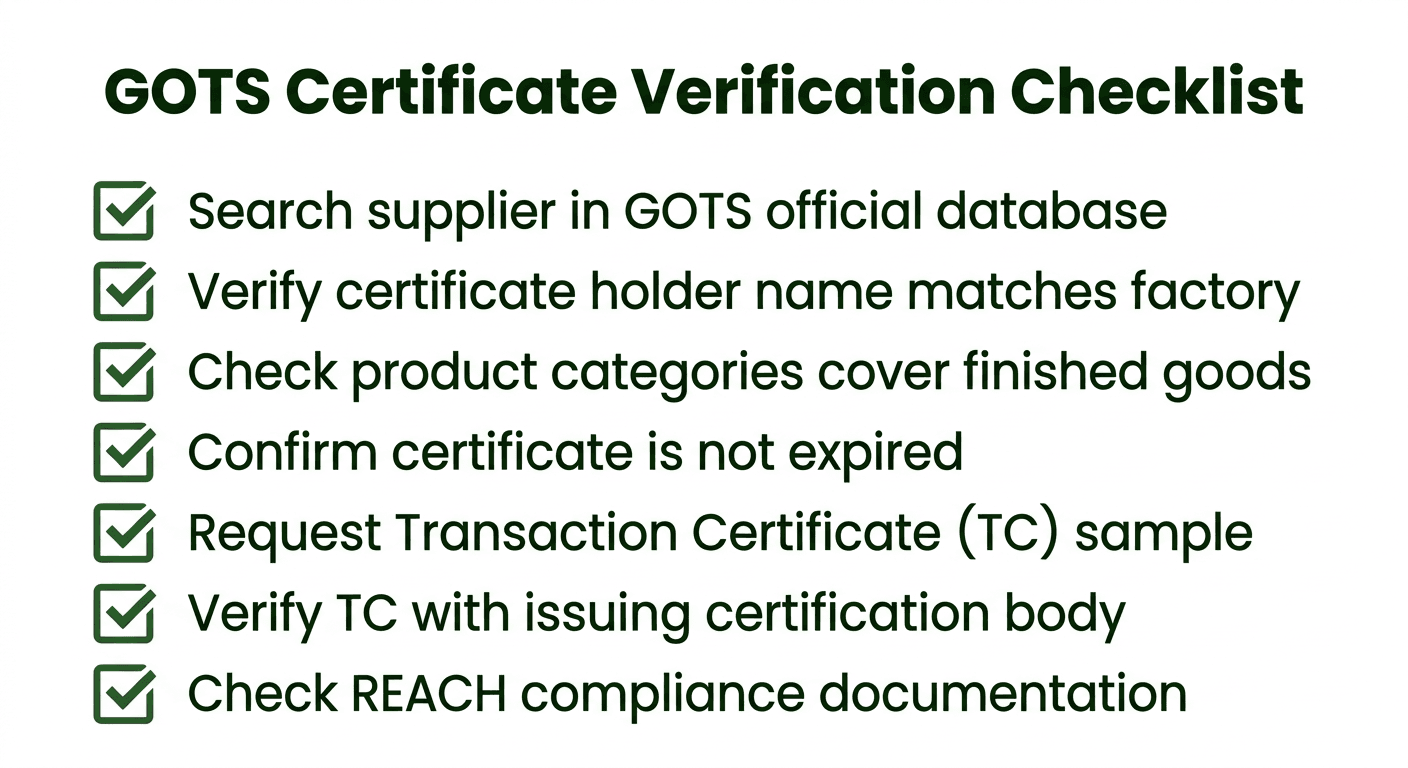
Total active time per supplier: under 30 minutes. Total elapsed time (including CB verification): 1–2 business days.
This is the minimum due diligence a brand should complete before placing an order they intend to market as GOTS-certified in the EU.
For a full walkthrough of the ordering process once your supplier passes verification, see our step-by-step checklist: How to Place a Compliant Organic Canvas Bag Order for the EU Market →
How Oasis Canvas Handles Verification.Our GOTS certificate verification process is fully transparent
We include our verification documentation as standard with every quote, not because buyers always ask, but because it removes the friction from due diligence.
When you request a quote from Oasis Canvas, you receive:
Our certification body is listed on our SC. Every TC we issue is verifiable directly with that CB. If you want to run the verification process above on us before placing an order, we will walk you through it.
Ready to request a quote? See what a fully loaded DDP price looks like before you commit: What Does a GOTS Organic Canvas Tote Bag Actually Cost? →
Request Your Verification Documentation Bundle →