
The Sourcing Decision That Affects Your Compliance
Choosing a supplier for GOTS organic canvas bags used to be straightforward: find the cheapest factory with a GOTS logo on their website, request a sample, place an order.
That logic stopped working in 2024. With the EU's Empowering Consumers for the Green Transition Directive (ECGTD) taking effect in September 2026, the sourcing decision is now also a compliance decision. The wrong supplier doesn't just mean quality problems, it means you cannot legally make organic claims on your product pages, hangtags, or marketing materials in the EU.
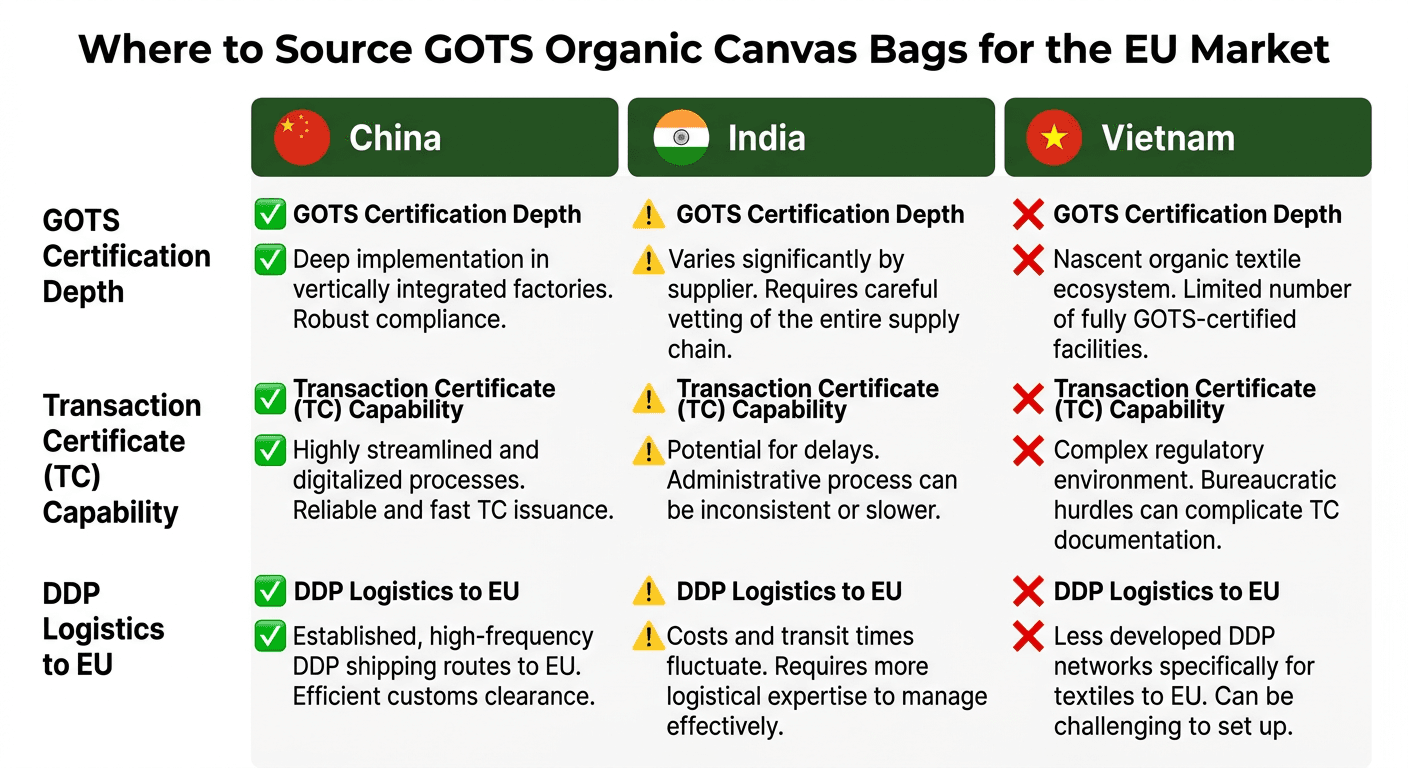
This guide compares the three dominant sourcing countries for organic canvas bags, China, India, and Vietnam, across the five dimensions that matter most to European buyers right now: GOTS certification depth, Transaction Certificate capability, DDP logistics, lead times, and MOQ flexibility.
5 Dimensions for Sourcing GOTS Organic Canvas Bags
Before diving in, here's the framework. For EU market access in 2026 and beyond, these are the questions that count:
China: Vertical Integration and TC Capability at Scale
China dominates global canvas bag production, and for GOTS-certified organic canvas specifically, it holds a structural advantage that India and Vietnam cannot easily replicate: vertical integration from cotton fibre to finished goods within a single certified supply chain.
The key distinction is the cotton supply chain. China's organic cotton-growing regions (primarily Xinjiang, though buyers should conduct their own due diligence on sourcing ethics, and Shanxi for conventional-to-organic transition farms) are directly connected to weaving bases that hold GOTS certification. This means the chain-of-custody documentation required for a per-order Transaction Certificate can be completed within one country, under one certification body audit.
GOTS certification depth: Strong. China has one of the highest concentrations of GOTS-certified facilities globally, covering spinning, weaving, dyeing, and finished goods manufacturing.
Transaction Certificate capability: Available, but varies by factory. Factories with fully separated organic production lines and documented chain-of-custody tracking can issue per-order TCs. Mixed-line factories (running organic and conventional on the same equipment) typically cannot. Always ask explicitly before ordering.
DDP logistics to EU: Well-developed. Major Chinese exporters have established freight-forwarding infrastructure for DDP delivery to EU ports and door delivery across Germany, the Netherlands, France, and beyond. Sea freight from China to EU typically runs 25–35 days.
Lead times: 30–45 days for production, plus 25–35 days sea freight = 55–80 days total from order to EU warehouse.
MOQ: Typically 500–1,000 pieces for certified organic runs.
.Best for: Brands that need TC documentation as standard, DDP pricing, and full OEM customisation (size, weight, colour, print).
India: Strong Cotton Origin, Uneven TC Infrastructure
India is the world's largest producer of organic cotton by volume, over 50% of global certified organic cotton is grown there. This gives Indian suppliers a genuine raw material advantage that China cannot match on origin alone.
The problem is what happens after the fibre leaves the farm.
GOTS certification depth: Variable. India has a large number of GOTS Scope Certificates across spinning and processing facilities, but the supply chain is fragmented. Many Indian organic canvas bag manufacturers source their certified cotton from one entity, spin it at another, weave at a third, and finish at a fourth. Each link in that chain needs to be GOTS-certified for the TC to be issuable, and many Indian factories have gaps in that chain.
Transaction Certificate capability: Inconsistent. Some larger, vertically integrated Indian manufacturers (particularly in Gujarat and Tamil Nadu) can issue per-order TCs. Smaller factories or those with fragmented supply chains typically cannot. This is a due diligence question you must ask explicitly, not assume based on a Scope Certificate.
DDP logistics to EU: Less developed than China for small-to-mid volume orders. Indian exporters typically quote FOB or CIF. DDP to EU door is available but less standard, and freight-forwarding infrastructure for SME-sized orders is thinner.
Lead times: 35–50 days production, plus 20–28 days sea freight to Northern EU = 55–78 days. Comparable to China, but quality consistency across production runs can vary more.
MOQ: Often 500–2,000 pieces depending on factory size and certification overhead.
Best for: Brands that prioritise cotton origin story (Indian organic cotton has strong provenance narrative for consumer marketing) and are working with larger, vertically integrated Indian manufacturers who can confirm TC issuance in writing.
Vietnam: Manufacturing Strength, Organic Supply Chain Weakness
Vietnam has become a serious alternative to China for canvas bag manufacturing, particularly for conventional cotton and recycled material bags. Its manufacturing quality, labour productivity, and export infrastructure are competitive.
For GOTS-certified organic canvas specifically, however, Vietnam has a structural problem: it does not grow organic cotton.
All organic cotton used in Vietnamese production is imported, primarily from India, China, or the US. That import adds a break in the chain-of-custody that must be documented and certified at every transfer point for a GOTS TC to be issued. Many Vietnamese factories hold a GOTS Scope Certificate covering their processing operations, but cannot trace the full fibre-to-finished-goods chain required for per-order TC issuance.
GOTS certification depth: Limited. Vietnam is one of the EU's largest textile exporters, but GOTS-certified organic production remains a small fraction of its output. Per a 2025 industry analysis, the share of GOTS-certified products in Vietnam's textile exports is low, making TC-capable factories rare.
Transaction Certificate capability: Weak. The combination of imported organic cotton, fragmented supply chains, and limited GOTS infrastructure means very few Vietnamese factories can reliably issue per-order TCs. This is the single biggest limitation for EU buyers post-ECGTD.
DDP logistics to EU: Improving but less mature than China. Sea freight to EU runs 28–38 days. DDP terms are available through freight forwarders but less standard.
Lead times: 35–50 days production, plus 28–38 days sea freight = 63–88 days total.
MOQ: Flexible, often lower than China or India for non-organic runs, but certified organic MOQs push higher due to documentation overhead.
Best for: Brands sourcing conventional canvas or recycled material bags where GOTS TC is not required. Not the right choice if EU organic compliance is a priority for 2026.
Side-by-Side: The Five Dimensions
The Question That Cuts Through All of It
Regardless of which country you source from, one question separates compliant suppliers from non-compliant ones:
"Can you provide a GOTS Transaction Certificate issued specifically for my order, with my company name, my invoice number, and this specific shipment, from your certification body?"
The answer tells you more about a supplier's real certification capability than any certificate they can email you.
How Oasis Canvas Is Structured for EU Compliance
Oasis Canvas operates a vertically integrated supply chain from its Shanxi weaving base (organic cotton sourcing and fabric production) through to its Yangzhou fulfillment hub (finished goods and export). Both facilities operate under GOTS certification with fully separated organic production lines and documented chain-of-custody tracking.
What this means in practice: every order placed with Oasis Canvas receives a GOTS Transaction Certificate issued for that specific shipment, your company name, your invoice, your goods. Not a shared Scope Certificate.
Every DDP quote includes:
Wondering what a compliant order actually costs? See our full DDP price breakdown →
Want to verify a supplier's GOTS certificates yourself? Follow our step-by-step due diligence guide: How to Verify a GOTS Certificate →